Big-Bag

How Q-Bag design reduces transportation costs

In the current landscape of unstable fuel costs and rising sea and land freight rates, logistics is no longer just an expense item, but akey opportunity to regain competitiveness.

It is often underestimated how the shape of a package can affect the entire value chain, but Q-Bags (stabilized Big Bags) are the ultimate solution for maximizing cargo volume and reducing costs.

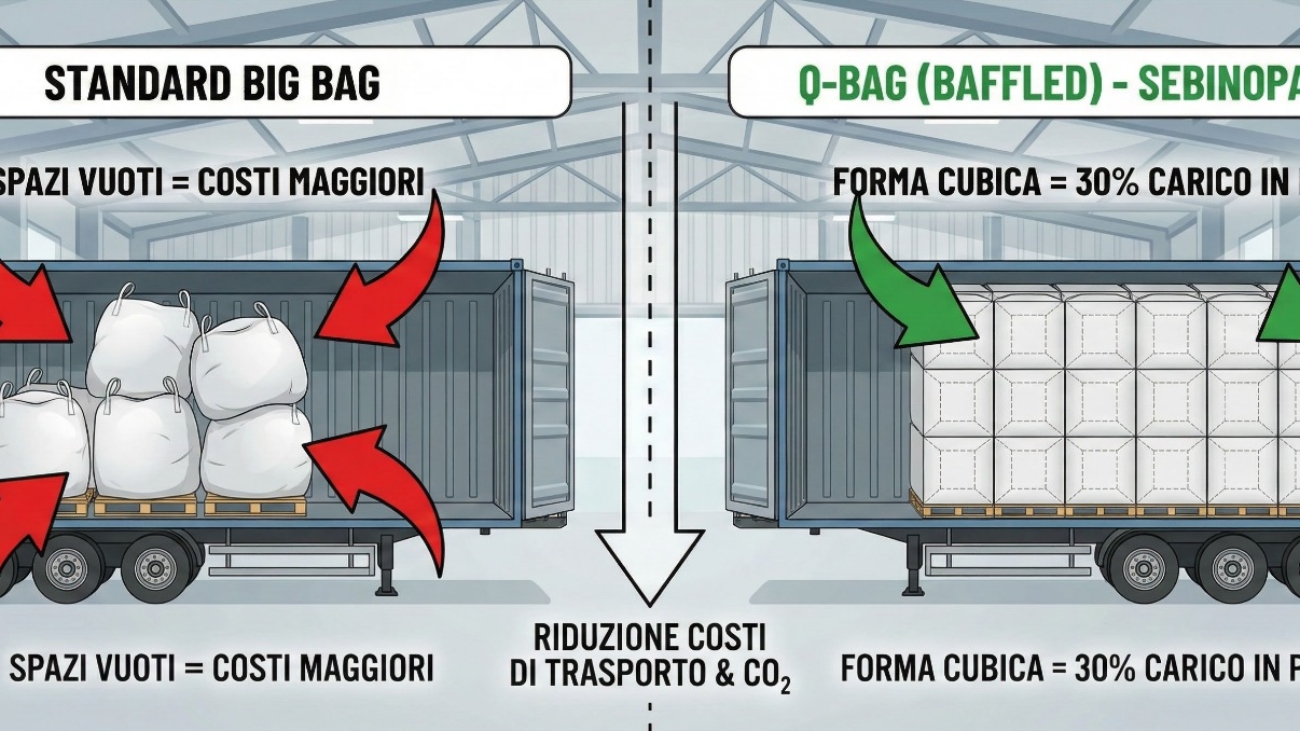
A standard Big Bag, when filled with granular or powdery materials, tends to span taking on a cylindrical or rounded shape. This phenomenon, creates two major inefficiencies: empty spaces and instability.

Q-Bags, on the other hand, are designed with aclever architecture. Inside the bag, reinforcing walls(baffles or baffles) are sewn into the corners. These baffles allow material to flow into the corners during filling and prevent the fabric from deforming outward. The result is a Big Bag that maintains a perfectly cubic shape even when fully loaded.

This allows up to 25-30% more material to be loaded into the same truck or container, and the more stable base allows bags to be stacked more securely, doubling or tripling the capacity of the warehouse without expanding its square footage.

Design optimization is not only good for the budget, but also good for the planet:

  • Reduction in the number of trips required to transport the same tonnage
  • Lower carbon footprint due to fewer vehicles on the road
  • Reduced risk of sagging or tipping during transport or storage

SebinoPack ‘s Q-Bags are distinguished by the precision of the internal seams, which ensure that the baffles do not collapse under the pressure of high-density materials. We also resize the bag to standard Euro-pallet orHigh Cube container sizes, ensuring that not an inch is wasted.
Big-Bag

UN-approved big bags for hazardous waste: regulations, UN codes, and mistakes to avoid

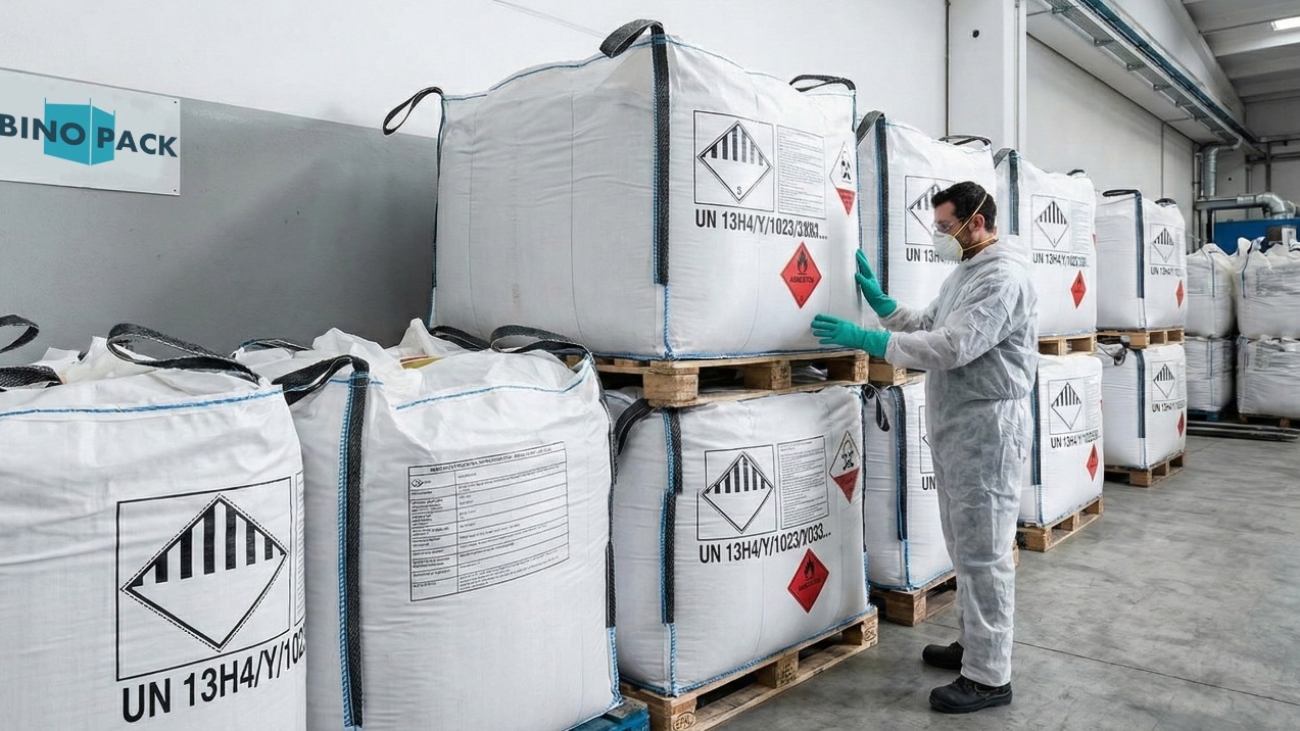
When it comes to hazardous waste, ADR, toxic-harmful waste or asbestos, a “sturdy” big bag is not enough. You need UN-approved packaging that is designed, tested and certified for the transport of dangerous goods according to the ADR regulations, RID, IMDG and the like.

UN-approved big bags (often identified as Dangerous Goods FIBCs) undergo specific tests for mechanical strength, drop, stacking, dynamics and tightness. Only after passing these tests can they bear the UN mark with all the required information: type of packaging, material, packaging group, year and country of manufacture, and certifying body.

In the field of waste, UN big bags are essential when the EWC code and classification of the waste make the substance a dangerous good for transportation purposes. Even more stringent is the case with asbestos: regulations require dedicated bags and big bags with clearly defined specifications for strength, closure, labeling and hazard symbology.

The most frequent errors found in business are:

  • Use of generic, unmarked UN big bags for waste that should travel in approved;
  • illegible or incomplete markings, exposing producer and transporter to penalties;
  • choice of bags with flow rates or safety factors that are not appropriate for the actual weight of the waste;
  • Incorrect outdoor storage, resulting in fabric degradation and loss of performance.

Working with a specialized supplier allows you to be guided in reading UN codes, verifying the ADR requirements of your waste stream, and choosing the right format (capacity, size, accessories). Sebino Pack can support both the waste producer and the environmental consultant in defining the correct UN big bag “familia” for the different types of waste handled.

Investing in approved packaging is not only a regulatory requirement, but a way to greatly reduce the risk of spills, loading/unloading accidents , and disputes with carriers and destination facilities.

Big-bag

Customizing Big Bags: operating instructions for a more efficient supply chain

The big bag is not just a neutral container-it can become a tool for communication and efficiency throughout the supply chain. Customization through printing and accessories allows branding, information and security to be combined.

On an aesthetic level, big bags can be customized by printing the company logo, product line name, institutional colors or coordinated graphics. This helpsarafforce the brand image, especially when the big bags are visible on the construction site, in the warehouse or by the end customer. For companies that do contract work, customized big bags can also become an additional service for their customers.

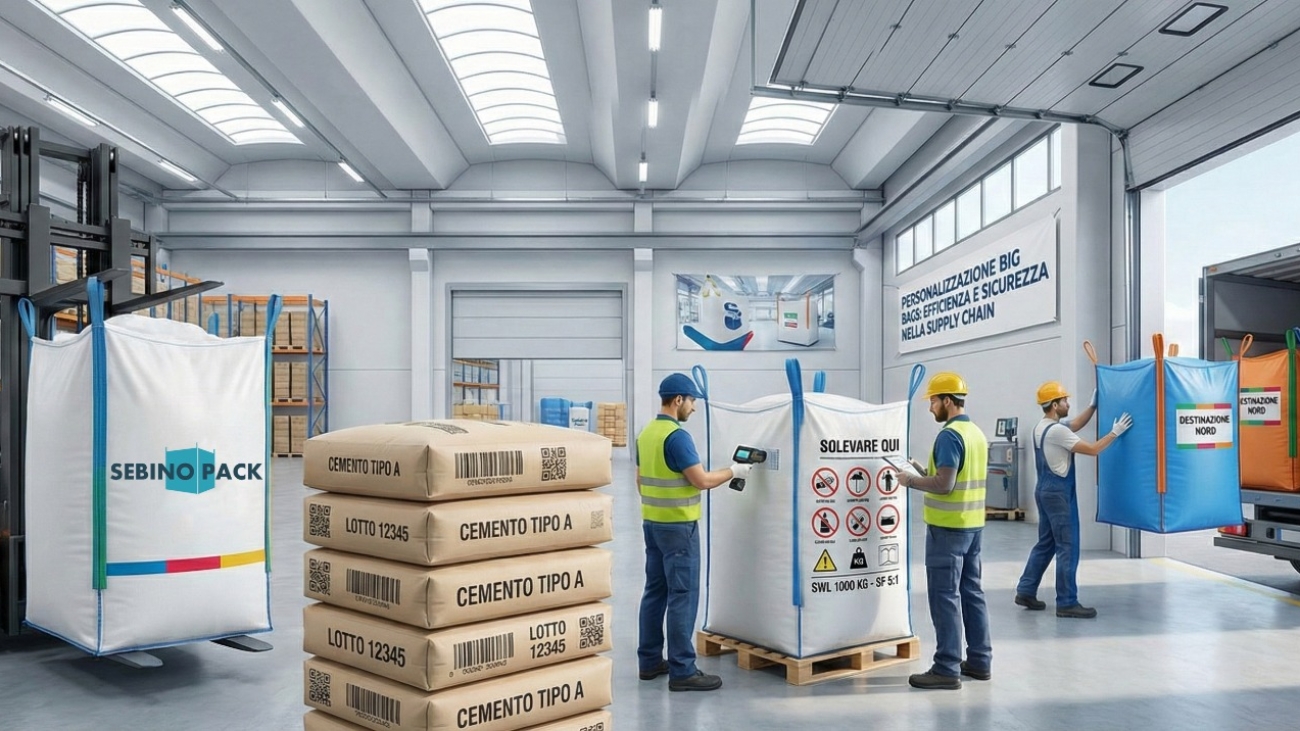
Operationally, the printout can contain key information: product codes, batches, bar codes or QR codes, safety pictograms, and lifting and storage instructions. Some companies choose to print capacity limits, safety factor and good usage practices directly on the bag, reducing the risk of errors in the department.

It is also possible to differentiate big bags by color or by graphic elements (side bands, colored seams) to quickly identify product families, risk classes, or destinations-an important advantage in warehouses with many different codes or in multilingual settings.

Customizing Big Bags requires a discussion between marketing department, logistics and supplier: format, number of colors, positioning of information, readability at a distance must be defined. Sebino Pack can support the company at this stage, preparing print proofs, color proofs and suggesting technical solutions to maximize graphic output without exploding costs.

A well-customized big bag simplifies the work of those who use it every day, reduces picking and shipping errors, improves the legibility of flows , and contributes to amore professional and consistentimage of the company.

Big-bag

Big Bag food grade: requirements, certifications and standards to know (BRC, HACCP, ISO 22000)

When a big bag comes into direct contact with food, it is no longer just industrial packaging: it becomes a MOCA(food contact material) and must meet very stringent requirements to ensure consumer safety.

A food grade big bag is made from virgin polypropylene suitable for food contact, produced in plants that apply strict hygiene standards (cleaning, pest control, access management, cleaning and maintenance procedures). Production processes follow HACCP methodologies, identifying critical points and defining specific controls to prevent physical, chemical or microbiological contamination.

At the regulatory level, in Europe the general reference is Regulation (EC) 1935/2004 on materials in contact with foodstuffs, flanked by specific provisions for plastics (such as Reg. (EU) 10/2011). To these are added voluntary standards, but in fact required by large industry, such as BRCGS, FSSC 22000, ISO 22000, IFS, SQF: certifications that attest to the structured management of food safety throughout the packaging supply chain.

A food grade big bag must be designed to minimize the release of substances from the material to the food: for this, global and specific migration tests are conducted under simulated conditions of use. Traceability is critical: each batch of bags must be able to be linked to the source materials, tests performed, and production conditions.

From the customer’s perspective, choosing a certified supplier means reducing the risk of noncompliance in audits, product recalls and disputes. It is important to ask:

  • Certificates of fitness for food contact;
  • List of standards/certifications of the production facility;
  • Summary reports of migration testing;
  • Foreign body and complaint handling procedures.

Sebino Pack, as a partner for the food industry, can select certified production facilities, ensure proper documentation for audits, and help clients define technical specifications for their food grade big bags.

Big-Bag

From quote to Just in Time delivery: how to optimize purchase and stock of Big Bags in the enterprise

Often the problem is not “which big bag to choose,” but “how to manage it over time.” Warehouses full of unused big bags, lack of stock in production peaks, difficulty in managing different codes-all of which generate hidden costs. A structured approach to buying and stocking big bags frees up space, cash and time.

The first step is to analyze actual removals: monthly volumes per item, seasonality, difference between forecast and actual consumption. Optimal minimum batches, reorder thresholds , and safety policies can be built on this data. In many cases it pays to reduce variances by standardizing sizes and configurations, and to use printing or labels to distinguish different products.

Just in Time logic applied to big bags means having a supplier capable of:

  • Ensure fast and stable deliveries,
  • Maintain a dedicated (or shared) stock quota,
  • Support the company in planning on a quarterly or semiannual basis,
  • Handle urgencies and peaks with a flexible logistics network.

A partner such as Sebino Pack can, for example, propose framework contracts with prices and conditions fixed for a period, combined with split deliveries according to actual needs. This allows the company to plan the cost of packaging, but without immobilizing large quantities of packaging in the warehouse.

Finally, it is useful to define a clear coding system shared between corporate ERP and supplier: internal codes, standardized descriptions, references to technical drawings or product sheets. In this way, even a change of buyer or logistics contact person does not generate confusion and wrong orders.

Optimizing the purchase and management of big bags is not just a matter of price: it means reducing errors, downtime, stock costs, and improving the reliability perceived by the end customer.

Big-Bag

How to choose the right Big Bag: materials, capacity, loading/unloading valves and accessories explained well

Choosing the right big bag means avoiding downtime, breakages, safety issues and disputes. This is why it is essential to start with an essential data sheet: what the big bag should contain, for how long, under what storage conditions, and how to load and unload.

The base material for big bags is woven polypropylene(PP) fabric, in different weights. Lighter fabrics are suitable for medium-low capacities and nonabrasive products; heavier weights are needed for high loads, aggressive products or repeated use. The fabric is often joined by internal plastic film liners, useful when a barrier against moisture, oxygen or contamination is needed.

The choice of load capacity(SafeWorking Load) and safety factor is a key step. The SWL indicates the maximum weight that the big bag can bear in operation, while the safety factor (e.g., 5:1, 6:1) describes the safety margin with which the bag has been tested. For single-use products in many industrial settings, a 5:1 is sufficient, while higher factors may be required for reusable big bags or for critical industries.

Another key element is the loading and unloading system. At the top we can find:

  • Open top (for rapid loading of aggregates),
  • fill skirt (which facilitates loading by reducing dust and dispersion),
  • loading valve (ideal for connection to hoppers and closed systems).

At the bottom, the most popular options are:

  • Closed flat bottom (for single use and discharge by tipping the bag),
  • Conical discharge valve (for controlled emptying),
  • Quick opening systems (“star”, “trap door” or similar bottoms).

Finally, the accessories: document pocket, sewn-in labels, additional tipping straps, specific seam colors, reinforcement bands, anti-UV treatments. Every detail can make a difference on automated lines or in harsh environments.

To avoid mistakes, it is helpful to share department photos, layouts, and handling methods with the supplier. Sebino Pack, for example, often starts with physical samples and inspections to propose a configuration that holds together safety, practicality , and cost per duty cycle.

Big-Bag

Big Bag: what they are, what they are for, and when they are convenient compared to other industrial packaging

Big bags, also called FIBCs (Flexible Intermediate Bulk Containers), are polypropylene fabric bags designed to contain and handle bulk materials in large quantities. They were created to make the handling of powders, granules, and aggregates easier, safer , and more efficient in all those cases where traditional bags or drums become inefficient or too expensive.

A standard big bag can hold from a few hundred kilograms up to 1,000-1,500 kg of product, depending on the rated capacity and safety factor. The woven polypropylene fabric provides mechanical strength, breathability or barrier (when combined with internal liners) and excellent handling during loading, unloading and storage. The four upper slots allow quick gripping with a forklift or crane, speeding up all logistics operations.

Big bags find application in a wide variety of sectors: construction (sand, gravel, rubble), chemical industry (powders, granules, additives), agriculture and animal feed (grains, seeds, feed), food (flour, sugar, milk powder), waste management and recovery. Wherever there is bulk material to be handled repetitively, the big bag makes it possible to reduce manual steps, loading times and risk of spills.

Compared with other industrial packaging, such as 25 kg bags, octabins, drums or cisterns, big bags offer some key advantages: reduction in the number of packages, optimization of travel and warehouse space, simplification of handling activities, and a better cost/ton handled ratio. In many cases, they also make it possible to reduce secondary packaging (films, additional pallets, cartons).

However, they are not always the ideal solution: for very small quantities, very high-value products or lines already optimized on 25 kg bags, the switch to the big bag should be carefully evaluated. A specialized partner such as Sebino Pack can support the company in the cost/benefit comparison, simulating impacts on warehousing, transportation and packaging lines.

In summary, big bags are the industry standard for handling large volumes of bulk materials. They become especially convenient when it is necessary to handle the same products often, reduce manual loading, and make the logistics flow from production to the end customer more seamless.

Big-bag

Big bags for flour, grain, sugar and bulk ingredients: how to ensure food safety and efficient logistics

Flour, cereals, rice, sugar, and many dry bulk ingredients are increasingly handled in big bags. This choice optimizes flows from milling to final packaging, reducing intermediate steps and improving process cleanliness. But the “food + powdered product” combination requires some extra attention.

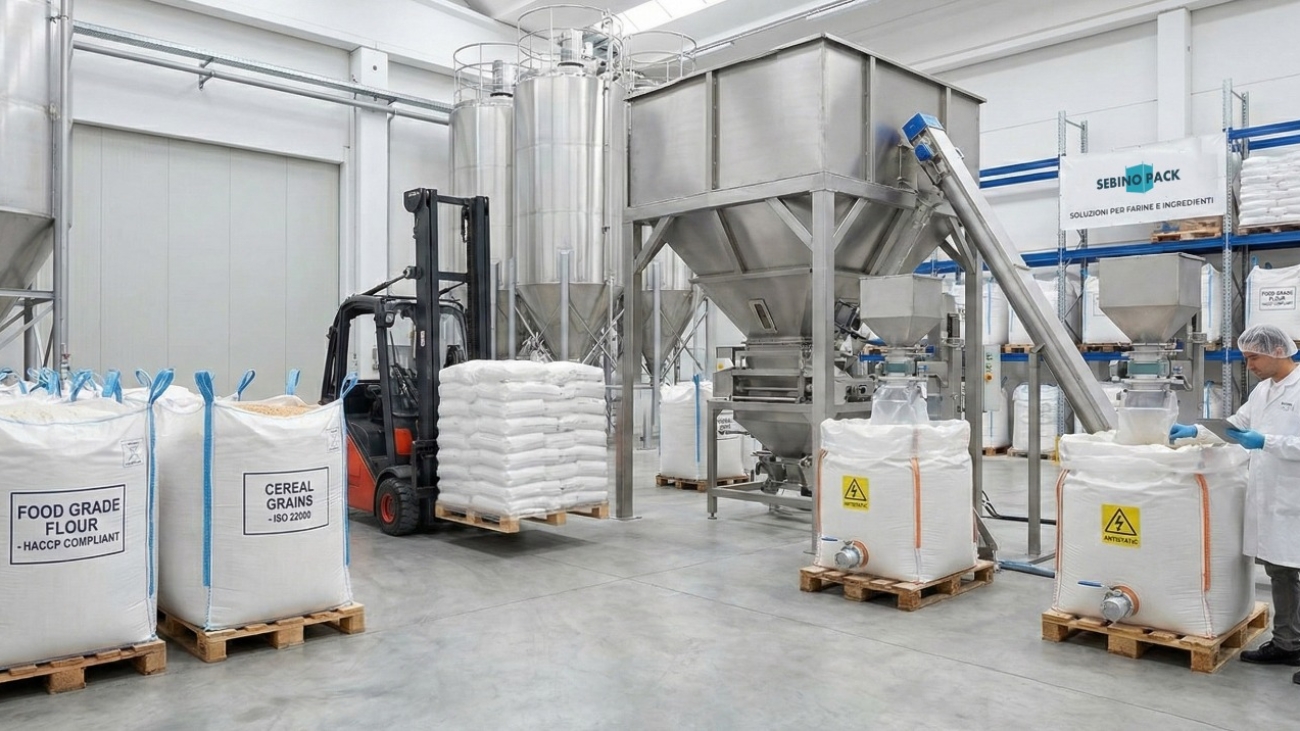
Operationally, the density of the product must be considered: very light flours volumetrically fill the big bag before reaching the weight limit, while high-density grains can quickly bring it to capacity limit. Properly defining the size and capacity of the big bag avoids both underutilization and overloading.

Dust and electrostatic charges are generated during filling and emptying : in some cases, especially in potentially explosive atmospheres, antistatic or conductive big bags (type B, C, D) and appropriate ATEX procedures should also be evaluated. The design of loading and unloading ports (valve, skirt, dust suppression systems) contributes greatly to the containment of dust emissions in the department.

Finally, logistics: big bags must integrate with silos, packaging lines, and automated warehouses. This means defining dimensions compatible with lifting systems, belts and storage spaces, but also providing identification systems (barcodes, QR codes, labels) that facilitate FIFO management and traceability by lots.

Sebino Pack can support mills, rice mills, confectionery companies, and ingredient manufacturers inanalyzing flows, proposing food grade and, when necessary, anti-static big bag solutions with configurations suited to the different steps (from harvesting to processing to final packaging).

Big-bag

Big Bag and sustainability: reuse, recyclability of polypropylene, and proper end-of-life management

Sustainability and packaging increasingly go hand in hand. Big bags, made mainly of polypropylene (PP), offer interesting opportunities from an environmental perspective, provided they are properly managed throughout their life cycle.

The first theme is reuse. Some big bags are designed as single-use, others as multi-use, with higher safety factors and stronger fabrics. When hygienic and safety conditions allow (i.e., when the product contained is not hazardous or contaminating), reusing big bags for multiple cycles significantly reduces the number of packages produced and disposed of. However, it is essential to establish clear procedures for inspection, cleaning , and discarding so that safety is not compromised.

The second issue is recyclability. Polypropylene is a thermoplastic plastic that is fully recyclable. At the end of its life, big bags can be collected, sorted, shredded, and fed back into processing circuits as a secondary raw material. The presence of liners, printing , or accessories in other materials requires a bit more management, but does not prevent recycling if organized properly.

To maximize recovery, it is useful:

  • Separate “clean” big bags from contaminated ones at the source;
  • compacting or baling the bags to optimize transport to recycling centers;
  • Collaborate with operators specializing in industrial PP recovery.

On the regulatory front, companies are increasingly required to demonstrate commitment to reducing environmental impacts, including through packaging. Designing lighter yet high-performance big bags, reducing secondary packaging, and encouraging reuse and recycling are concrete levers for improving sustainability indicators.

Sebino Pack can support clients in choosing more sustainable solutions (e.g., optimized fabrics, reuse projects, monomaterial solutions that are easier to recycle), while also sharing best practices that have already been tested in other contexts.

6

Big Bag for the construction industry: how to safely manage aggregates, rubble and yard waste

In building and construction, big bags are now an indispensable tool. They are used for sand, gravel, and powdered cement, but also for rubble, excavated earth, and demolition waste. The challenge is to combine robustness, practicality and compliance with waste management regulations .

For “clean” aggregates (sand, gravel, cement, stone materials) standard high-capacity big bags with open tops to facilitate loading with shovels or belts are often sufficient. Resistance to abrasion and outdoor conditions is important in these cases: anti-UV treatments and appropriately weighted fabrics enable the big bag to withstand prolonged outdoor storage.

For mixed rubble and demolition waste, in addition to strength, the practicality of loading and unloading matters a lot: big bags with filling skirts or with “open and close” structures make it possible to contain the material without leakage and to empty it in a controlled manner at the landfill or recovery facility. In urban construction site situations, reducing dust and spills is also an image issue to the client and residents.

When handling special waste (containing asbestos, paints, solvents, hazardous materials), UN-approved big bags and ADR specifications come into play. In these cases, dedicated big bags must be used, with hazard symbology, legible labeling and data sheets readily available for inspection.

Another critical issue is safe handling: intact slots, proper ways of lifting with cranes or trolleys, prohibition of dragging bags on the ground, visual checks before each use. Training site managers and operators on these issues dramatically reduces the risk of accidents.

Sebino Pack can provide the construction company with a set of differentiated solutions for the most common uses (aggregates, rubble, special waste), standardizing formats to simplify ordering and management on different construction sites.