


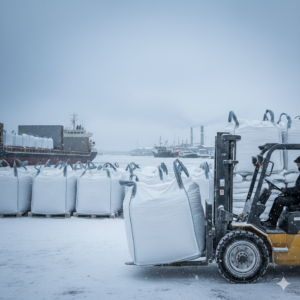
Big Bag below zero: the resilience of polymers in the ice inferno
Imagine a northern European port in the middle of winter. The thermometer reads -30°C and everything seems immobilized by frost. In this extreme scenario, thousands of tons of goods rest inside Big Bags (FIBCs) stacked in yards or ship holds.

Big Bag’s “shark skin”: coatings to defy abrasion
In industrial packaging, strength is not just a matter of weight, but of surface area. When the load consists of extreme materials, the container must evolve to survive. The internal attack: when content becomes the enemy Transporting sharp ores or

The Achilles of the Big Bag: why the real strength lies in the seams
It is often said that a chain is only as strong as its weakest link. In the world of industrial packaging, and particularly FIBCs (Flexible Intermediate Bulk Containers), that link is the seams. You could invest in the strongest polypropylene

Big Bags vs. rigid silos: why flexibility is the key to cutting costs
In the material handling industry, one of the most critical strategic decisions concerns the storage system. Many companies, driven by a traditional view, immediately consider installing rigid silos. However, a thorough analysis of investment costs (CAPEX) and operational needs reveals

Big bag wear: how to read the signs of multi-trips
In the world of circular logistics, a multi-trip Big Bag (6:1 certified) travels, supports immense loads, is emptied and refilled. But like any veteran, it collects “scars” over time. For a safety manager, being able to distinguish between a surface

Big bags vs. floods: when packaging becomes a life-saving levee
We are used to seeing Big Bags at construction sites or large logistics hubs, filled with polymers or grain. Yet in recent years, an “off-the-shelf” use has been spreading strongly: Big Bags as emergency flood barriers . In civil defense

Lifting an elephant in a handkerchief: understanding the Safety Factor 6:1
Imagine having to cross a suspension bridge with your car. If the sign indicates a limit of 2 tons, would you feel safe knowing that the bridge was designed to collapse at exactly 2.1 tons? Probably not. In the packaging

The steel web: the science behind the polypropylene weave of Big Bags
There is an engineering paradox that travels every day on thousands of trucks and cargo ships: a container that weighs just over 2 kg is capable of lifting and protecting over 2 tons of material. If we were to compare

Automation in Big Bag filling and emptying
The integration of Industry 4.0 into logistics processes has transformed the flexible container from a passive element to a critical component of the automated cycle. The statistics speak for themselves: it is estimated that more than 60 percent of large